Health and Safety Policy for Landscapers in Carshalton
 This health and safety policy sets out the standards expected from landscaping work carried out by landscapers in Carshalton and across the wider service area. It is designed to support safe, consistent practice on domestic and commercial sites, including projects involving garden maintenance, turfing, planting, hard landscaping, and rubbish removal services. The aim is to reduce risk to staff, clients, visitors, and members of the public while maintaining a clean, organised working environment.
All employees, subcontractors, and supervisors are expected to follow safe systems of work, use equipment correctly, and report hazards promptly. The policy applies to routine tasks as well as more demanding operations such as lifting materials, using powered tools, handling soil and waste, and working near roads or shared access routes. Good housekeeping, careful planning, and responsible rubbish disposal are essential parts of safe landscaping practice.
 We recognise that landscaping can involve changing conditions and physical hazards. Surfaces may be uneven, machinery may be in use, and waste materials can create trip, cut, and contamination risks. For that reason, all work must be assessed before it begins, with control measures put in place to protect everyone on site. This policy is intended to promote safe working habits and a professional standard of care throughout each project.
Risk Assessment and Planning
Before any job starts, a suitable and proportionate risk assessment must be completed. This should identify hazards such as unstable ground, overhead obstructions, buried services, sharp materials, manual handling strain, weather exposure, and interactions with vehicles or pedestrians. Where rubbish clearance forms part of the job, the type, volume, and weight of waste should also be checked so that the correct lifting methods, containers, and disposal arrangements are used.
Work must only proceed when the team understands the task, the sequence of operations, and the required controls. Safe access and exit routes should be maintained, especially where piles of cuttings, bags, rubble, or other waste may cause obstruction. Carshalton landscapers working on tight residential plots, shared driveways, or larger commercial grounds must take particular care to keep pathways clear and secure.
Weather conditions should be monitored throughout the day. Rain, frost, heat, and strong winds may affect ground stability, visibility, or the safe use of tools. Where conditions become unsafe, work must pause until risks can be managed properly.
Safe Use of Tools, Machinery, and PPE
All tools and machinery must be suitable for the task, maintained in good condition, and used only by trained personnel. Pre-use checks are required for fuel levels, guards, blades, cables, brakes, and general wear. Defective equipment must be taken out of service immediately. This applies to mowers, hedge cutters, strimmers, compactors, and other powered landscaping tools.
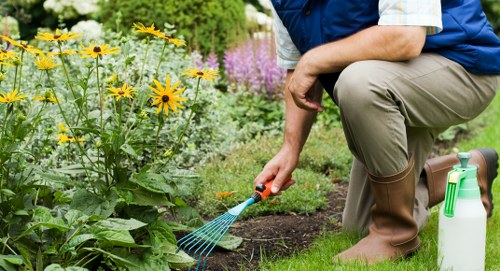 Personal protective equipment must be worn where necessary and may include safety boots, gloves, eye protection, hearing protection, high-visibility clothing, and dust masks. PPE should be selected according to the hazard and kept clean, inspected regularly, and replaced when damaged. Although PPE is important, it should never be treated as a substitute for proper controls, training, and supervision.
Manual handling is a major concern in landscaping and rubbish handling. Employees should avoid lifting awkward or heavy items alone whenever possible. Techniques such as bending the knees, keeping loads close to the body, and splitting heavy waste into smaller loads must be used. Mechanical aids should be used for soil, paving, aggregates, and bulky rubbish where practical.
Waste, Rubbish, and Site Housekeeping
Good housekeeping is central to this policy. Offcuts, packaging, loose materials, broken items, and green waste must be collected regularly and stored in a safe, designated area before removal. Rubbish should never be left where it can block access, attract pests, or create a fire hazard. Rubbish company service area operations must be organised so that waste is separated where required and loaded securely for transport.
Waste streams should be managed responsibly, with recyclables, green waste, inert materials, and general rubbish handled in line with current requirements and site arrangements. Spills, sharp debris, and hazardous items such as chemicals or contaminated containers require immediate attention and appropriate disposal methods. Where possible, the team should aim to reduce waste at source through careful material ordering and efficient use of resources.
At the end of each shift, the site must be left in a safe and tidy condition. Tools should be returned to storage, access ways checked, and any remaining rubbish secured. This final inspection helps prevent incidents after work has finished and supports a professional standard of service for every landscaping project.
Training, Supervision, and Reporting
 All workers must receive suitable training for the tasks they carry out, including manual handling, safe machinery use, waste segregation, and emergency procedures. New starters and less experienced staff should be supervised until they are competent. Refresher training should be provided when work methods change or when new equipment is introduced.
Any accident, near miss, unsafe condition, or damaged equipment must be reported as soon as possible. Early reporting helps prevent repeat incidents and supports timely corrective action. Supervisors are responsible for reviewing incidents, identifying causes, and implementing improvements. Safety concerns must be treated seriously, regardless of how minor they may appear.
Everyone working under this policy is expected to take reasonable care of their own safety and the safety of others. Cooperation, clear communication, and attention to detail are essential, particularly on busy sites where multiple tasks may happen at once. A disciplined approach helps ensure that landscaping services in Carshalton remain safe, efficient, and well managed.
Emergency Arrangements and Review
 Emergency procedures must be understood before work begins. Teams should know how to respond to injuries, fires, utility strikes, severe weather, and exposure to hazardous substances. First aid provisions should be available, and routes for emergency access must remain clear at all times. Where work involves waste removal or site clearance, extra care should be taken to identify hidden hazards within piles of material.
This policy will be reviewed regularly to make sure it remains effective, practical, and aligned with current legal expectations and operational needs. Updates may be made following incidents, changes in equipment, new working methods, or amendments to legislation. The objective is to maintain a safe framework for landscaper health and safety across all projects, from garden care to heavier clearance work.
By following this policy, the business promotes a safer workplace, reduces avoidable risk, and supports reliable service delivery. Whether the task involves planting, groundwork, maintenance, or rubbish removal, every job must be approached with care, planning, and a commitment to safety.

